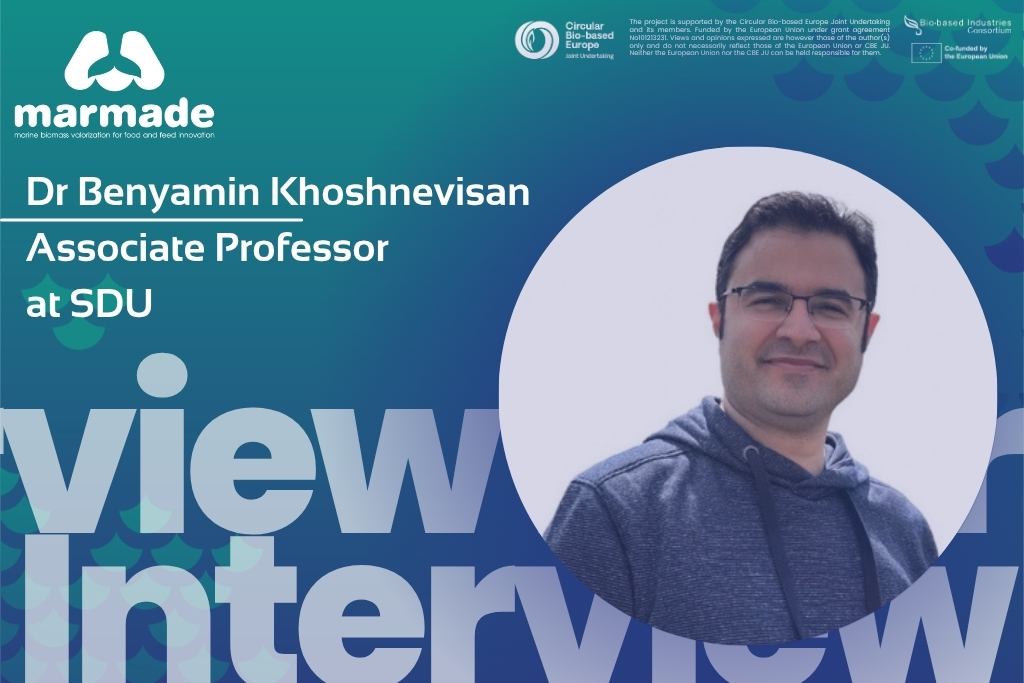
Dr Benyamin Khoshnevisan
Creating innovative bio-based ingredients is only part of MARMADE’s mission. Understanding their environmental, social, and economic impacts is equally important to ensure they contribute to a truly sustainable and circular bioeconomy.
In this edition of Voices of MARMADE, we meet Dr Benyamin Khoshnevisan from the University of Southern Denmark (SDU), who leads Work Package 5 and coordinates the sustainability assessment of MARMADE solutions across their full value chains.
“As WP5 Leader, my role is to ensure a comprehensive assessment of the sustainability performance of MARMADE solutions across their full value chains.” explains Khoshnevisan.
WP5 evaluates the environmental, social and economic impacts of marine-based food and feed ingredients. Its work follows a Safe and Sustainable by Design approach, integrating life cycle thinking from the early stages of development.
The team applies quantitative assessment methods including Life Cycle Assessment, Social Life Cycle Assessment and Techno-Economic Analysis. These dimensions are then integrated through Multi-Criteria Decision Analysis, allowing alternative solutions to be compared and potential trade-offs between sustainability dimensions to be explored.
“This approach ensures that sustainability is systematically embedded into the development and optimization of processes and products.” Khoshnevisan
WP5 also explores the potential of AI-assisted quantitative assessment to support robust and trustworthy decision-making during the early stages of innovation. This could help researchers assess possible sustainability outcomes while technologies and processes are still being developed.
Evaluating the full life cycles of marine-based ingredients, however, involves significant challenges. Early-stage technologies are often accompanied by limited data and uncertainty regarding future technological development. Sustainability results may also be influenced by broader socio-economic changes, including the evolution of energy systems.
The complexity of marine biomass systems presents another challenge. Feedstocks can vary considerably, while different processing pathways and approaches to co-product valorisation may lead to different outcomes. In addition, comparing alternative solutions requires decisions on how environmental, social, economic and safety indicators should be weighted.
“While multiple sustainability dimensions can be assessed, determining how to weigh different indicators in decision-making remains a key question when comparing alternative solutions.” says Khoshnevisan.
Embedding these assessments throughout the development process helps MARMADE identify trade-offs, compare alternative pathways and guide the design of solutions with stronger environmental, social and economic performance.