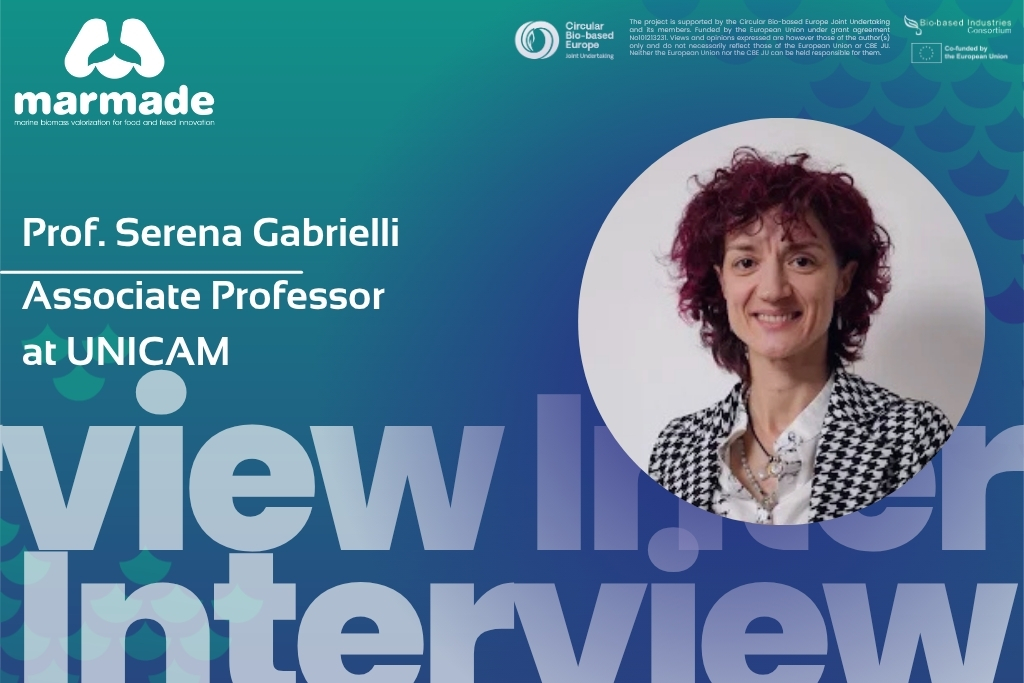
Associate Professor Serena Gabrielli
Turning marine biomass into valuable food and feed ingredients requires more than identifying promising compounds. It also requires efficient, sustainable and carefully designed processes to recover them. Within MARMADE, Work Package 2 focuses on developing the biorefinery approaches that make this transformation possible.
As Work Package 2 Leader, Associate Professor Serena Gabrielli from the University of Camerino (UNICAM) coordinates the development of sustainable processes for extracting high-quality building blocks from marine biomass, following a zero-waste concept.
WP2 focuses on optimising extraction methodologies and technologies to obtain high-purity biomolecules and produce quality ingredients for use in subsequent stages of the project. Its activities cover three main areas: developing selective extraction methodologies for crustacean residues, optimising extraction technologies for seaweed biomass, and integrating the best-performing processes into an overall workflow.
A key element of this work is MARMADE’s cascading biorefinery approach, which uses sequential extraction methods to maximise the valorisation of the different components contained in marine biomass. Technologies such as supercritical CO₂ extraction, Deep Eutectic Solvents, the Naviglio extractor and ultrasound are being explored to recover valuable compounds including lipids, astaxanthin, proteins and chitin/chitosan.
“MARMADE employs cascading biorefinery approaches to marine biomass by sequential extraction methods that maximise the valorisation of all biomass components.”
The approach goes beyond extraction efficiency alone. The project aims to optimise process parameters, integrate the most effective technologies and evaluate the overall process from a Life Cycle Assessment perspective, helping ensure that the selected pathways are aligned with environmental sustainability objectives.
Moving from laboratory-scale extraction to scalable and sustainable processes, however, presents several challenges. Marine biomass can vary considerably making process standardisation more difficult. At the same time, technologies must be scalable, energy-efficient and cost-effective while maintaining the quality and purity of the recovered biomolecules.
Waste management, regulatory compliance and the need to minimise environmental impacts add further complexity.
“Addressing these challenges requires innovative solutions and interdisciplinary collaboration.” explains Serena
Optimising extraction processes and integrating the best-performing approaches are key to MARMADE’s goal of effectively valorising marine biomass. Through innovative solutions and interdisciplinary collaboration, WP2 is working towards high-quality ingredients for future food and feed applications.